

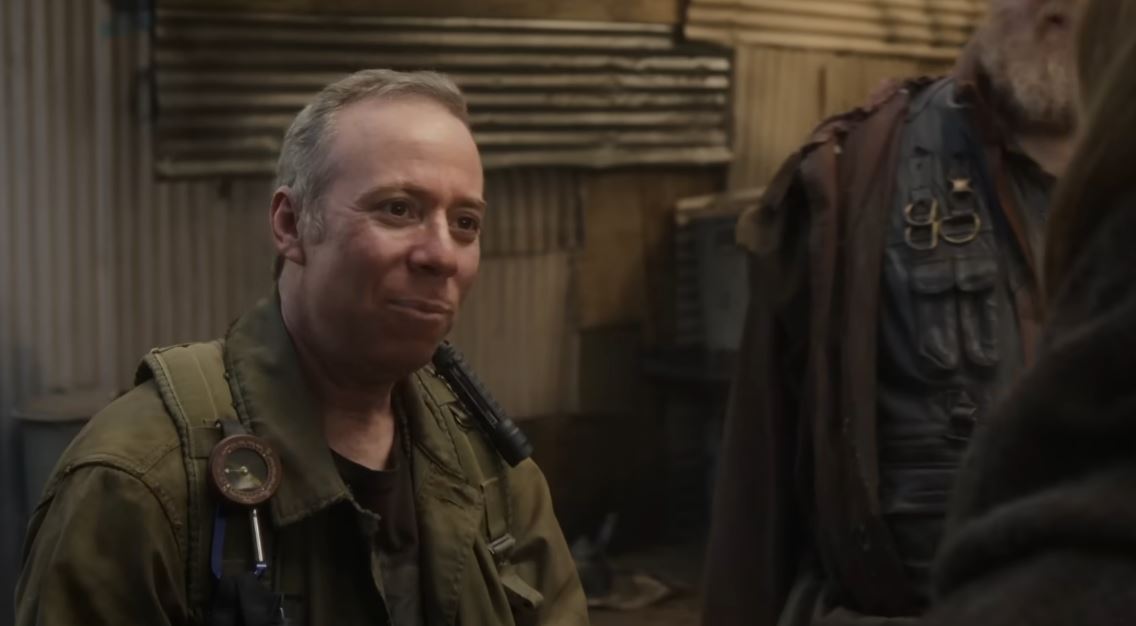
The idea of creating a spinoff centered around the comic book store owner is subtly daring. Not Sheldon. Not Leonard. Not Penny. For twelve seasons, Kevin Sussman portrayed Stuart Bloom, a recurring character who hovered around the periphery of everyone else’s story and was always unlucky and charmingly melancholic. He is now the one leading the franchise, as Stuart Fails to Save the Universe will debut on HBO Max on July 23, 2026.
It’s an odd kind of wager. However, the more you understand how this show was put together, the less bizarre it seems.
Chuck Lorre, who, as he has acknowledged, built an empire out of two people chatting on a couch, spent years speculating about what the Big Bang universe’s next chapter might entail. Another prequel wasn’t the solution. It wasn’t a special reunion. Four supporting characters in the science fiction action-adventure comedy unintentionally start a multiverse apocalypse. Co-creator Bill Prady refers to it as a “Doctor Who/Black Mirror/Big Bang Theory/Hitchcock mashup,” which sounds like something you’d overhear at a pitch meeting and brush off right away, but then you realize Prady said it with a straight face, and perhaps he meant it.
The origin story is strangely endearing. The modestly successful superhero drama series Alphas on Syfy, which aired in 2011 and 2012, was a favorite of Lorre’s. In a Big Bang episode, he had even made Sheldon lament its cancellation.
After meeting Zak Penn, the co-creator of Alphas and the feature writer behind multiple X-Men and Avengers movies, Lorre reportedly became a “fanboy.” Penn joined the project because it wasn’t a conventional sitcom spinoff. He was drawn to the fact that it was something stranger. Prady then joined, and it seems that’s when things really started to fall apart. The two years of “wonderful lunches” without any real script momentum came to an end. They began to write.
It’s easy to underestimate the deliberateness of what they settled on. The idea puts Stuart and three other supporting Big Bang characters—Denise, Bert Kibbler, and Barry Kripke—in the middle of a multiversal crisis brought on by a gadget that Sheldon and Leonard created. The original show’s main cast is not present. Skeptics will almost certainly start by pointing out that absence. And it’s a legitimate worry. However, the premise itself contains a counterargument: audiences already like these characters without ever having to do so.
In the last seasons of Big Bang, a romance quietly blossomed between Stuart and Denise, played by Lauren Lapkus. It didn’t have much time to breathe; the show concluded, and that was it. His character’s life was “just getting good again” just before the curtain fell, according to Sussman. Picking up that thread again, about seven years later in the timeline, in a multiverse where everything is collapsing, is genuinely fascinating. The Big Bang franchise has always done a better job of combining absurdism and melodrama than it is given credit for.
The format itself is more difficult to predict. The show heavily relies on visual effects and alternate-universe storytelling, and the episodes are reportedly shorter than a typical half-hour comedy. For a creative team that established its reputation for verbal humor in cramped settings, that is a big change. Lorre has been open about the unease. He expressed a desire to push himself and enter “unfamiliar territory.” It’s comforting to see such creative honesty. Furthermore, nothing is guaranteed by it.
Prady compares the show’s tone to that of Hitchcock, with regular people thrust into extraordinary circumstances for which they are totally unprepared. It’s a wise intuition. When the universe seemed to be deliberately ignoring Stuart, he was always at his most captivating. Making that trait the driving force behind a science fiction comedy instead of merely a joke could be what makes the entire project worthwhile.
It’s genuinely unclear whether Stuart Fails to Save the Universe genuinely captures something new or merely capitalizes on nostalgia for characters who were never well-known enough to evoke nostalgia. HBO Max is making significant investments. The cast is enthusiastic. The creative team is working outside of their comfort zones, which is typically either a good omen or a warning sign, and it’s nearly impossible to predict which beforehand.
It’s safe to say that this isn’t a cynical, money-grabbing spinoff. With a franchise that could have easily settled for less, it’s an odd, ambitious, and a little overly complicated attempt to do something different. Perhaps the best metaphor for that would be Stuart Bloom unintentionally shattering the universe.
