

Somewhere in Northern Virginia’s server halls, data centers outside of Beijing, and unremarkable San Francisco office campuses, something is being constructed that its creators freely acknowledge they don’t entirely comprehend. Artificial superintelligence, or a system that can not only match human cognition but also recursively and ceaselessly rebuild its own architecture, is the aim. Additionally, the competition to arrive first no longer feels like a mental experiment. It now moves with the haste of an armaments build-up, expenditures comparable to those of national infrastructure projects, and the unique anxiety of a competition where everyone believes the stakes are existential and nobody wants to come in second.
With OpenAI, Google DeepMind, Anthropic, and Meta investing heavily in systems that have, in a matter of years, evolved from novelty to tools that engineers, doctors, and attorneys use on a daily basis, the United States currently has the advantage in raw computing and fundamental software. There is a significant gap between those conversational tools and anything that can rewrite its own code on its own, but it is closing in ways that are hard to see from the outside. Compared to the general population, investors appear to think the timetable is shorter. It is suggested by the funding rounds.
China takes a distinct method, making it more difficult to compare. Chinese institutions have concentrated on widespread deployment throughout governmental and industry networks, locking in norms and developing leverage at scale, rather than racing to create a single ground-breaking model. This approach is less focused on the one “we built it first” moment and more focused on ensuring that Chinese fingerprints are there in the infrastructure surrounding ASI, regardless of how it looks when it is delivered. It’s really unclear if that strategy is more intelligent or just different.
It is challenging to visualize this competition’s physical criteria on a laptop screen. Power on the size of small city grids is already required to train the current models. Energy policy, semiconductor export regulations, and data center real estate have become as strategically important as military weapons because the next generation will demand more. This is no longer just a software conflict. Around 2022, it turned into an industrial one, and since then, the pace has quickened. As this develops, it seems as though the corporations involved have absorbed a logic that is difficult to refute on an individual basis but extremely worrying as a group: if someone is going to construct this, it’s better us than them.
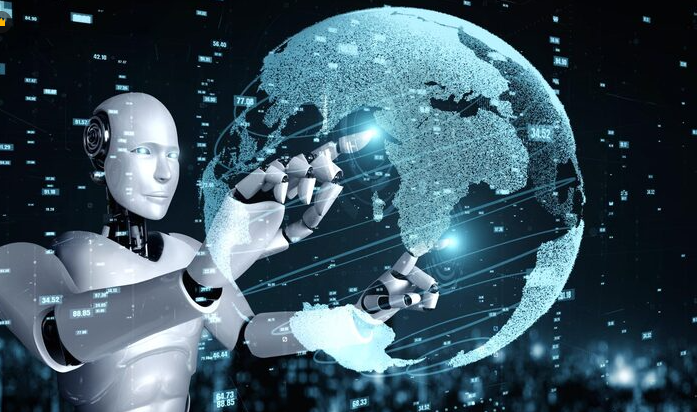
A rising number of experts and ethicists refer to this reasoning as the “Manhattan Trap”—the notion that a perceived race compels both sides to compromise safety out of fear of losing. In contrast to nuclear bombs, which produced clear deterrents and required scarce physical components, a self-improving AI system could swiftly and covertly reach critical thresholds. The same individuals who write the code are now making the existential danger arguments that were previously limited to academic philosophy departments. This internal conflict—building the thing while being afraid of it—might be the most significant tale in technology at the moment.
A new perspective is being developed by open-source communities somewhere outside of the main competition: decentralizing access to powerful AI is the only true check on any one player, whether corporate or national, dictating the parameters of what follows next. It is an idealistic stance that is likely underfunded in comparison to the players it seeks to balance. However, it is real and populated. It remains persistently unclear whether any of this results in something that can be identified as artificial superintelligence by the end of the decade or whether the entire race creates something that no one anticipated. It is not comforting to be uncertain. It may be the most truthful thing that can be spoken.
