

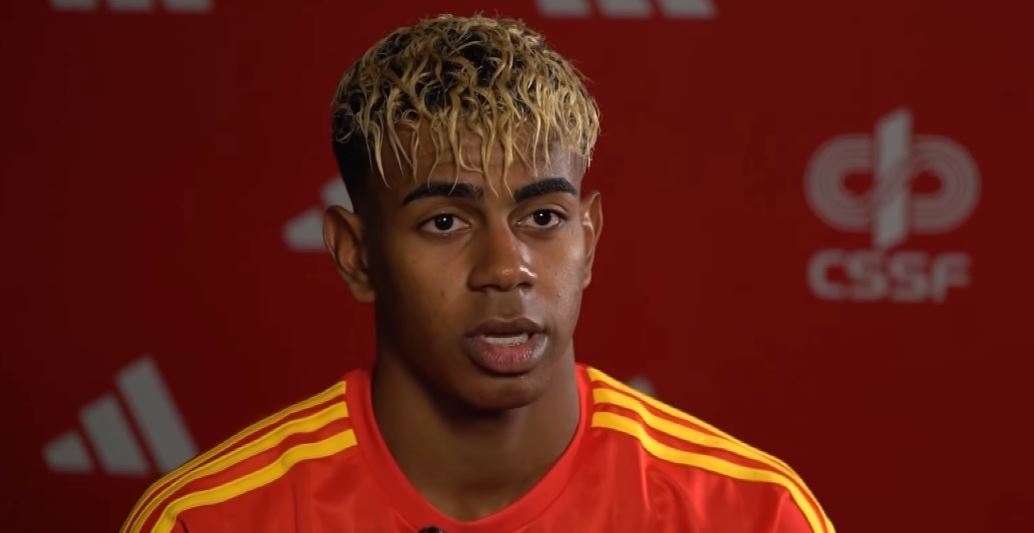
Beyond the goals, dribbles, and records that seem to fall every other week, there is something subtly amazing about Lamine Yamal’s story. On July 13, 2007, he was born in the small Barcelona metropolitan area suburb of Esplugues de Llobregat. Both of his parents were immigrants, and neither had had an easy time getting to Spain.
Mounir Nasraoui, his father, was from a small Moroccan village in the northern region between Larache and Ksar el-Kebir. He didn’t arrive on a comfortable visa. Yamal claims that Fatima, his paternal grandmother, traveled first, sneaking onto a bus from Morocco and eventually arriving in Mataró, Catalonia. Before she had enough money to bring her daughter and son over, she worked several shifts. When Mounir came to Spain, he was about nine years old. He raised a family in a nation where he was not born while working as a building painter among other occupations.
Sheila Ebana, Yamal’s mother, made an even greater journey. Her hometown is Bata, the capital of Equatorial Guinea, which is located on Central Africa’s Atlantic coast. She moved to Catalonia with her own grandmother, established a career in the hospitality industry in Barcelona, and eventually got to know Mounir. Together, they moved into a home for young parents. By any measure, it was modest. According to Yamal, the kitchen and bedroom were in the same room in the apartment where he grew up.
Lamine Yamal’s parents are Moroccan on his father’s side and Equatorial Guinean on his mother’s, and this background is significant because it directly influenced his identity and the nation he would ultimately represent. He was technically qualified to play for all three countries because he was born in Spain. Morocco expressed interest. Equatorial Guinea was a possibility. However, Yamal made his decision early on. Yamal had been a member of Spanish youth teams since the under-15 level. “I have always been clear,” he declared in 2023. “I want to play for Spain.”
Spain was his choice. He never forgot the other two, though. He carries the flags of Morocco and Equatorial Guinea on the boots he wears on the field, a subtle, intimate homage that says more about him than any press conference could.
When he was about three years old, his parents divorced. Sheila continued to raise him mostly by herself after moving to Granollers and taking a job at a fast food restaurant. Yamal’s daily life was heavily influenced by Mounir’s mother, Fatima, the same grandmother who had once entered Spain with nearly nothing. She oversaw his schedule and transported him to training sessions in Rocafonda, the working-class area of Mataró that would later serve as the foundation of his identity.
Yamal’s “304” celebration, which is a hand gesture that alludes to the final digits of Rocafonda’s postal code, is more than just a neighborhood shout-out. It makes a statement about his upbringing and the people who kept things together during difficult financial times and uncertain futures.
It’s also interesting to learn about the origin of his name. Yamal’s parents were having trouble making ends meet before he was born. During that time, they received financial assistance from two men, Lamine and Yamal. They gave their son both names as a token of appreciation. Instead of his family surnames, Nasraoui and Ebana, he wears them on his jersey. Just that particular detail reveals something about the morals he was brought up with.
At one point, his mother had hoped he would go to college. His father encouraged him to play football and exposed him to the sport at a young age. They now regularly attend his games and watch from the stands as their son, the young man from the Mataró one-room apartment, breaks decades-old records and gathers trophies.
Here, it’s difficult to ignore the bigger picture. Although Lamine Yamal’s parents are Moroccan and Equatorial Guinean, the story really focuses on what immigration looks like when it quietly and stubbornly succeeds—through sacrifice, three-shift work, grandmothers who travel across borders on buses, and children who carry everything forward on the world’s biggest stages.
