

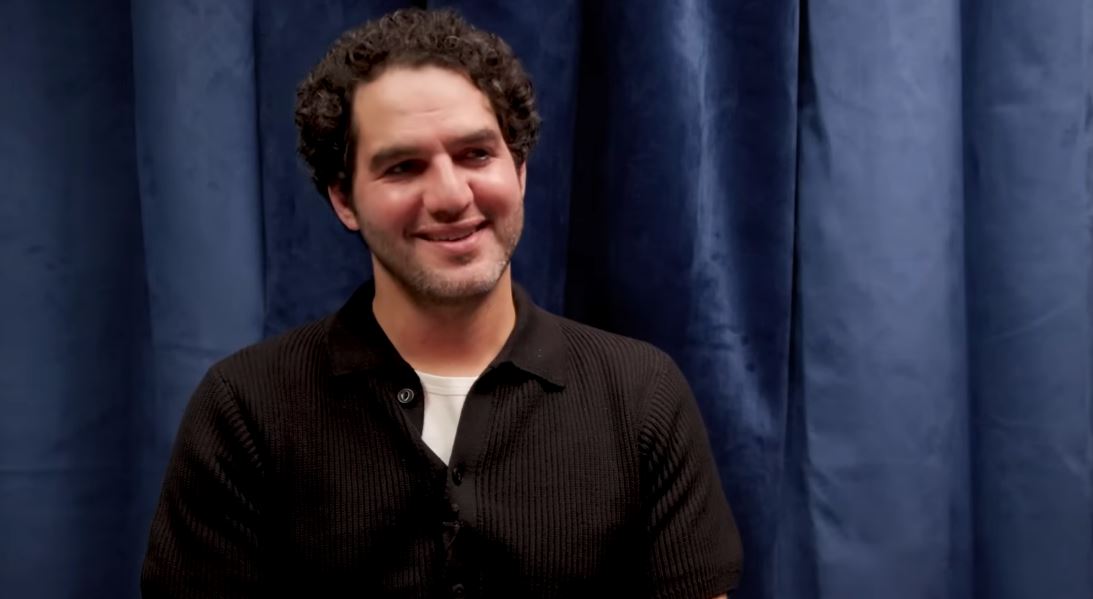
The fact that one of the more important issues surrounding Christopher Nolan’s The Odyssey concerns the physical dimensions of a director who used to spend his days filming grainy, frantic movies on the streets of New York City is almost subtly humorous. Benny Safdie, the co-director of Good Time and Uncut Gems, is currently being measured, quite literally, against a Homeric war king. Safdie’s creative identity has always been tough and grounded. As it happens, the answer is that he does fairly well.
Depending on the reliable source, Safdie’s height is roughly 6 feet 1 inch, or 1.85 meters. It is slightly higher, at slightly less than six feet one inch, according to CelebHeights. When Nathan Fielder estimated Safdie’s height to be 6’2″ during an interview with IndieWire, Safdie responded with his trademark self-deprecating correction: “6’1″ on a good day.” It’s a brief exchange, but it reveals something about Safdie’s demeanor: he isn’t particularly concerned with projecting grandeur, even when his frame might justify it.
When you take into account the part he has been given in The Odyssey, that small understatement becomes somewhat significant. According to Homer’s Iliad, Agamemnon, the king of Mycenae and the leader of the Greek army at Troy, was taller than the men surrounding him and towered over the rest of the Achaean host. That puts the literary Agamemnon between 6’2″ and 6’5″ when translated into approximate modern measurements. Safdie falls short of that ceiling, but he’s so close that it hardly shows on screen, especially after Nolan’s costume department puts him in that massive black helmet with its eerie golden vertebral detail.
But Safdie’s use of physicality is more intriguing than the numbers. Agamemnon is mostly silent, armored, and appears in flashbacks throughout The Odyssey. In a paradoxical way, this restraint makes him more powerful. It seems like Nolan recognized that Safdie’s on-screen persona doesn’t make a big statement. It builds up. As you observe him, you gradually come to the realization that the room has rearranged itself around him.
Nolan has previously called on Safdie for precisely that trait. In Oppenheimer, Safdie portrayed Edward Teller, the physicist from Hungary who is credited with creating the hydrogen bomb. He spent a lot of time honing his adopted accent. He worked with Nolan on the character’s texture, listened to recordings, and discovered something that seemed almost intimate. He told Vulture at the time that as a teenager, he had dreamed of becoming a nuclear physicist. It was more than just an acting role to play Teller. It was more akin to a long-overdue convergence of interests.
From the outside, Safdie’s acting career appears almost accidental, but the closer you look, the more intentional it seems. Around 2017, he began making appearances in movies other than his own, discreetly accumulating a portfolio that now includes Judy Blume’s Are You There God? and Paul Thomas Anderson’s Licorice Pizza. It’s Me, Margaret, and The Curse, a Showtime series he co-wrote and co-created with Nathan Fielder. The point is probably that each role has been sufficiently different from the previous one to make it difficult to categorize him.
In the meantime, his directing career has evolved. His first feature film without his brother Josh, The Smashing Machine, debuted in Venice in 2025 and took home the Silver Lion for Best Direction. It’s a real turning point, the kind of acknowledgment that, in hindsight, completely changes someone’s trajectory.
Aside from his height, Benny Safdie’s suitability for Agamemnon and Nolan’s movies in general is more difficult to measure than inches. There’s something about the way he inhabits a character without going into too much detail. Safdie doesn’t seem to need dialogue to convey the weight of Agamemnon, a figure characterized by both victory and disaster in equal measure. You believe him when he simply stands there wearing that massive helmet. More than any measurement, that is most likely the reason Nolan gave him another call.
