

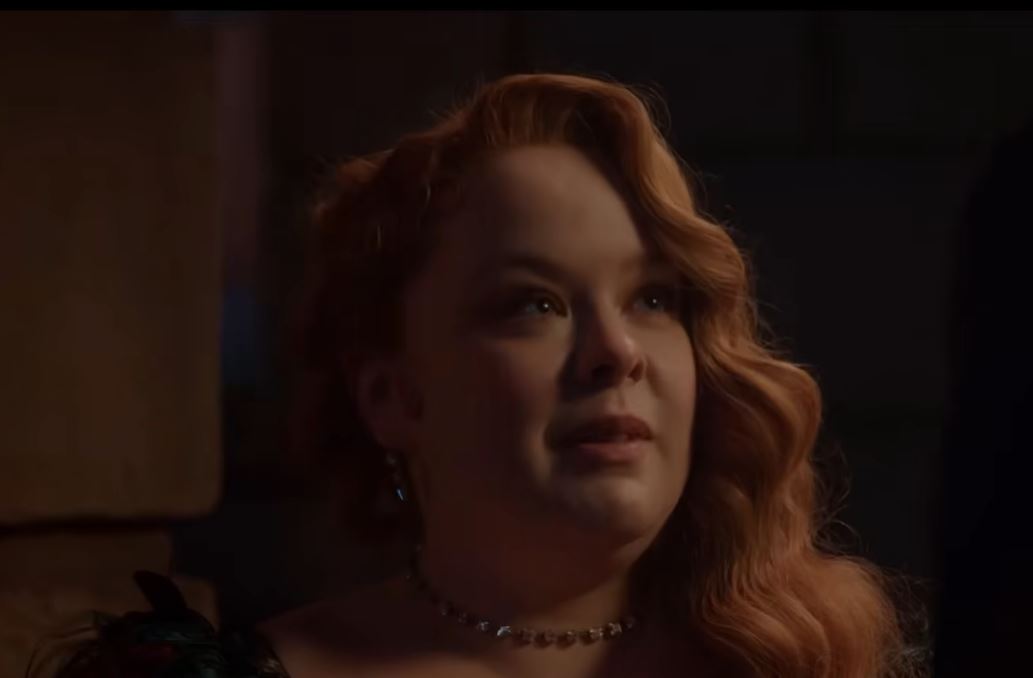
Early in the third season of Bridgerton, there’s a scene that stays with you longer than it probably should. During a fictitious flirtation exercise, Colin Bridgerton, who has just returned from his European adventures and is brimming with newfound swagger, sits opposite Penelope Featherington. She should be practicing small talk. Rather, she says something surprisingly candid, and his expression shifts for a split second. Not in a big way. Only a flicker. After that, they both act as though it never happened. It’s a brief beat, perhaps five seconds on screen, but it conveys a message that Hollywood has been attempting, and largely failing, to convey for years. Two individuals who are already acquainted and have feelings for one another are on the verge of transforming their friendship into something completely different.
In all honesty, one of the earliest formulas in romantic storytelling is the friends-to-lovers trope. It comes before movies. It comes before the book. Despite its widespread popularity, screen adaptations have had difficulty with it in ways that neither the enemies-to-lovers plot nor the fictitious dating arrangement have. The issue has never changed: where is the tension? What is stopping two people from liking and trusting each other? In the majority of sloppy retellings of this tale, the solution is nonexistent, which explains why a lot of friend-to-lovers films seem uninteresting. The third season of Bridgerton had to address that issue, and it did so in a variety of inconsistent but frequently genuinely clever ways.
Since the first episode of the show, Penelope Featherington had harbored feelings for Colin. As Lady Whistledown, she wrote about the romantic entanglements of the ton while her own love life remained painfully stagnant for three seasons. She also stood on the periphery of ballrooms and watched him dance with other women. Penelope felt lived-in rather than pitiful because of the specificity with which Nicola Coughlan portrayed all of this. A character who pines is not the same as one who aches, and Coughlan discovered the latter. By the time season three arrived, viewers were impatient for Penelope rather than just supporting her.
The show was aware that Colin’s side of the story was more complex. Colin ran the risk of coming across as someone driven more by sympathy and guilt than by true attraction, as NPR’s Linda Holmes noted. At the conclusion of season two, he was overheard telling his friends that Penelope was unimportant. This incident cast a shadow over their entire relationship.
The authors addressed this in part by giving Penelope a makeover that included new colors, styling, and a confidence she had been concealing, as well as in part by making Colin jealous as he watched Lord Debling get closer. The solution wasn’t ideal. One could argue that Colin only became aware of Penelope after other men did, and that he never really earned his revelation. However, there’s also a painfully realistic aspect to that. People frequently fail to notice what is directly in front of them. Sometimes clearing the fog requires the attention of another person.
The foundation beneath the Polin romance was what gave it resonance despite its flaws. These weren’t strangers using conflict or deceit to create sparks. They had a long history together, inside jokes, and quiet times of sincere concern. The scenes worked because you could sense the weight of everything that had come before when Colin bandaged Penelope’s hand and they stumbled through their first kiss, which was motivated more by desperation than by confidence. The season’s main theme, according to showrunner Jess Brownell, is stepping into who you truly are. This framework transformed what could have been a straightforward will-they-won’t-they into something more complex. Because of their romance, both characters—Colin as the worldly rake and Penelope as the quiet wallflower—had to reveal their true selves.
The carriage scene, which quickly became a cultural phenomenon, was successful because it felt inevitable rather than because it was especially explicit by prestige television standards. Three seasons of accumulation, close calls, and intense looks, all crammed into one small area. Within days, millions of social media edits featuring longing ballads were made. The scene was all over the place. And that kind of mainstream obsession felt like a real change for a trope that Hollywood had mostly given up to Hallmark films and formulaic romantic comedies.
It’s important to note that not everyone enjoyed Bridgerton’s friends-to-lovers plot. Some fans thought Colin’s character was underdeveloped in comparison to earlier Bridgerton leads, the execution was hurried in some places, and the conflict surrounding Lady Whistledown’s identity was overdone. These criticisms are valid. One thing, though, seemed to unite even the doubters: the trope itself is still effective. No amount of enemies-to-lovers squabbling can quite match the emotional payoff that occurs when two people who truly know each other—who have witnessed each other at their most ordinary, embarrassing, and unguarded—choose each other anyhow. Penelope and Colin’s love story was not perfect. They produced something better: evidence that an audience can still hold their breath when the friends-to-lovers formula is executed with sufficient heart and patience.
