

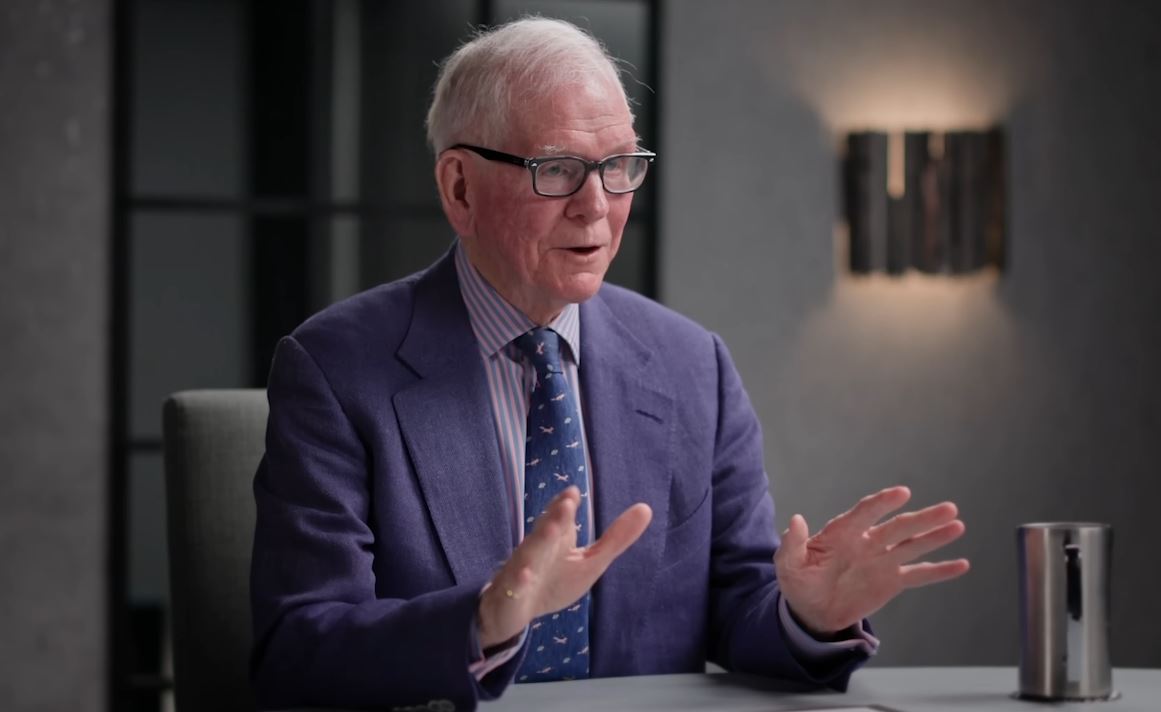
Jeremy Grantham has a subtle peculiarity. Despite having a personal fortune of approximately $1 billion, managing tens of billions of dollars for others, and spending decades forecasting market collapses, he prefers to discuss the carbon bubble and resource depletion rather than his personal wealth. You can learn a lot about how he got here from that contrast.
Grantham was born in Ware, Hertfordshire, in 1938 and raised in Doncaster, which isn’t exactly the setting you would expect for one of Wall Street’s most closely watched investors. Before earning his MBA from Harvard Business School in 1966, he studied economics at the University of Sheffield. There was no clear path to prosperity after that. It was something more complex: a lengthy career based on patience, contrarianism, and frequently being correct when it would have been more comfortable to be incorrect.
Grantham, Mayo, Van Otterloo & Co., his company, formerly oversaw assets worth more than $118 billion. Depending on the time frame, that amount has since decreased to about $65 billion. Over 200 publicly traded stocks make up his company’s portfolio, which has been valued at over $44 billion in recent quarters. These jobs span a wide range of industries, including semiconductor-related businesses, healthcare, insurance behemoths like Cigna, and clean energy companies like Sunrun and Array Technologies. It’s not the portfolio of a guesser; rather, it’s a broad, methodical spread.
Mean reversion has always been the central tenet of Grantham’s investment philosophy. When markets become excessively hot or cold, they eventually return to historical averages. Every single time. He likes to point out that of the 34 completed bubbles he and his team have examined, none have failed to collapse all the way back to trend. In an industry that frequently views the previous quarter as ancient history, that kind of long-term thinking is uncommon.
The disparity between his personal net worth and the wealth he oversees is intriguing. Grantham’s $1 billion estimate has been in circulation for years; it has been mentioned in interviews and reported by media outlets covering his increasingly vocal market warnings. Obviously, it’s a substantial figure. However, it is small in comparison to the amount of capital he has managed. That could be partially intentional. Through the Grantham Foundation for the Protection of the Environment, which he and his wife Hannelore founded, Grantham has donated significant amounts of money. The foundation has allocated substantial funds to environmental causes and climate research. Giving may have had a greater influence on the net worth figure than any market error.
He dubbed it the “dot-com bubble.” Prior to 2008, he identified the housing bubble. In interviews conducted in 2021 and 2023, he issued another warning, estimating the likelihood of a significant market correction to be between 70 and 85 percent. He claimed that the AI rally had caused a delay. but did not completely remove the danger. The majority of investors with this level of pessimism don’t typically create enduring wealth. Grantham has, in part because his approach involves rotating, repositioning, and finding true value while others are still chasing the bubble rather than just sitting back and waiting for catastrophe.
Additionally, at the age of 87, he has expressed opinions in ways that seem less deliberate than moral. He has advocated for taxing the extremely wealthy more heavily. For environmental reasons, he has opposed pipelines. In 2026, he co-wrote The Making of a Permabear, a book that examined decades of booms and busts. There’s a feeling that a $1 billion person who consistently warns that the market is going to crash isn’t solely driven by self-interest. Whether or not this next correction occurs will likely determine whether he is noble or obstinate.
In the end, Grantham’s wealth is a reflection of a certain type of discipline: the discipline to be unpopular, to perform poorly during prosperous times, and to maintain the position long enough to be justified. It’s more difficult than it seems. Most people find it intolerable. It seems that he can.
