

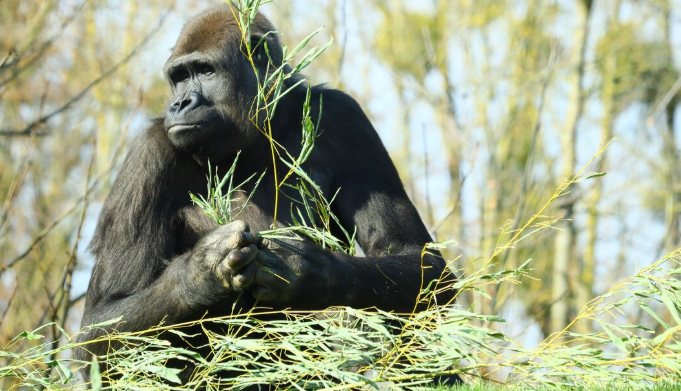
For forty years, people have remembered a particular moment from Koko’s 1985 National Geographic interview. In a room in the Santa Cruz Mountains with a 300-pound western lowland gorilla, author Cynthia Gorney questioned Koko about what happens to gorillas after they die. Penny Patterson, her trainer, gave her the sign language response, “Comfortable hole bye.” When people read that, something changed. Impossibly, it appeared to be the start of a discussion with another species about mortality. The question that has never been fully answered is whether it truly was.
On July 4th, 1971, Koko was born at the San Francisco Zoo and given the Japanese name Hanabi-ko, which means “fireworks child.” Patterson, a Stanford graduate student studying animal psychology at the time, started working with her when she was around a year old using a modified form of American Sign Language. The husband-and-wife team of Allen and Beatrix Gardner had been working with a chimpanzee named Washoe in a trailer behind their Reno home since 1966, so it wasn’t the first attempt at ape-language research.
| Full name / birth name | Hanabi-ko (“fireworks child” in Japanese); known as Koko |
| Species | Western lowland gorilla (Gorilla gorilla gorilla) |
| Born | July 4, 1971 — San Francisco Zoo, California, USA |
| Died | June 19, 2018 (age 46), in her sleep |
| Lead researcher | Dr. Francine “Penny” Patterson — animal psychologist; began working with Koko in 1972 |
| Institution | The Gorilla Foundation (co-founded by Patterson and Ronald Cohn); based in the Santa Cruz Mountains, California |
| Language system used | Modified American Sign Language (ASL); Koko used approximately 1,000 signs |
| Spoken English comprehension | Reportedly understood ~2,000 spoken English words (per The Gorilla Foundation) |
| Notable appearances | Two National Geographic covers (1978, 1985); viral video with Robin Williams (2001); multiple documentaries |
| Scientific controversy | Linguists and scientists debated whether Koko used true language or learned conditioned responses prompted by trainers |
| Related subjects | Washoe (chimpanzee, Gardners, 1966), Nim Chimpsky (Columbia University, 1973), Kanzi (bonobo) |
| Conservation status (species) | Critically endangered (IUCN Red List) |
| Reference / source | National Geographic — Why Koko the Gorilla Mattered |
However, Koko became the most well-known subject by a wide margin, appearing on the cover of National Geographic twice, interacting with Robin Williams on camera in 2001, and gaining a public profile that most researchers never attain. Millions of people have watched the video of her and Williams playing together, with Koko laughing and trying on his glasses.
A particular and genuinely fascinating scientific conundrum gave rise to the ape language experiments of the 1960s through 1980s. A chimp named Viki was able to learn four words—mama, papa, cup, and up—after nearly seven years of intensive exposure.
Previous attempts by researchers to teach chimps to speak English had dismal results. Because chimp vocal tracts aren’t designed for human speech, the Gardners surmised that anatomy rather than cognition was the issue. They switched to sign language when they saw that Viki was making hand gestures while she was having trouble forming sounds, and all of a sudden the results appeared much more promising. During her first three years, Washoe picked up 85 trustworthy signs and used them in combinations. The field became available.
Looking back, it’s possible that the enthusiasm surrounding those initial findings caused researchers to perceive more than was actually present. The most rigorous of the ensuing experiments was conducted by Herbert Terrace at Columbia University in 1973 using a chimp he called Nim Chimpsky, a play on linguist Noam Chomsky. Nim picked up signs.
However, Terrace discovered something that had gone unnoticed during the research itself when he watched his own video footage after the study was over: the trainers were constantly prompting Nim, and the responses were being interpreted as sentences when they were, at most, loosely connected gestures. Terrace became one of the most well-known critics in the whole field. He maintained that the apes were learning sophisticated begging instead of developing language.
In the midst of all of this, Koko’s case is neither conclusively proven nor conclusively refuted. When she passed away in June 2018 at the age of 46, almost all of the obituaries were joyous, with headlines stating that she had “mastered” sign language. Linguists immediately retaliated. Koko learned a modified set of signs rather than American Sign Language, which is an important distinction, according to Dr. Adam Schembri of the University of Birmingham.
Koko did not employ any of the full, grammatically complex linguistic systems found in sign languages like ASL, which make coordinated use of hands, body, and face. According to Heriot-Watt University professor Graham Turner, the recorded data repeatedly showed trainers prompting responses and then interpreting individual gestures as connected sentences. Linguists generally agree that Koko lacked a clear understanding of syntax, which is the structural foundation that distinguishes learned gesture from language.
However, the skeptics also fail to provide a complete explanation for everything. The toilet comment is one of them. When Koko first met Gorney, she used sign language to call her a toilet. When Patterson reprimanded her, she warmed up and completely changed her behavior.
The social awareness, humor, and receptivity to correction in that sequence seem to go beyond simple conditioning. Watching the video gives the impression that the question isn’t just “language or not language” but rather something more complicated and difficult to classify. Koko appeared to comprehend her circumstances in ways that are difficult for basic stimulus-response models to account for.
The field was fundamentally split by the larger ape language experiments involving Washoe, Nim, Koko, and the bonobo Kanzi, who demonstrated perhaps the most convincing linguistic abilities of any ape subject. Since then, research has mostly moved on, focusing on how apes interact with one another in the wild rather than attempting to teach them human systems. Regardless of one’s opinion of the methodology, the experiments did show that there is less of a cognitive difference between humans and great apes than most people believed in 1966. Just knowing that was worthwhile.
From the San Francisco Zoo to several research facilities, Koko lived her entire life in captivity. She was never quite in either world because she was too human to be a gorilla and too human to be anything else. It’s difficult to ignore the fact that this specific expense hardly ever made headlines. Decades of scientific debate centered on the question of what she could and could not say. Less attention was paid to the question of what she went through—growing up in a trailer, surrounded by people, signing at cameras. Both seem worthwhile inquiries.
