

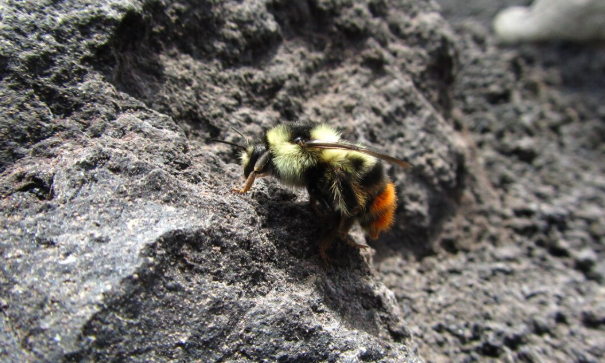
Scientists’ preconceived notions about one of nature’s most important insects were unintentionally upended by a lab refrigerator mishap, and what they discovered raises more significant concerns about survival in a warming world.
Imagine a Canadian laboratory refrigerator humming softly in the background of a University of Guelph research building. There were rows of tiny tubes inside, each containing a single bumblebee queen that was loosely packed in soil and in a state of suspended winter sleep. Pesticides were the subject of the experiment; it was routine, methodical, and unremarkable. When Sabrina Rondeau, a researcher, opened the refrigerator, she discovered that several of the vials had been silently flooded overnight by condensation. The queens were fully immersed. She thought they were dead. She used forceps to pick one up, and it moved.
| Field | Details |
|---|---|
| Species studied | Common eastern bumblebee (Bombus impatiens) |
| Lead researchers | Sabrina Rondeau (postdoctoral researcher) & Charles-Antoine Darveau (comparative physiologist) |
| Institution | University of Ottawa, Canada; originally initiated at University of Guelph |
| Study published | March 11, 2026 — Proceedings of the Royal Society B |
| Key finding | Diapausing bumblebee queens can survive submersion for over 8 days, breathing underwater via gas exchange and switching to anaerobic metabolism |
| Survival rate | ~90% of submerged queens survived up to one week underwater in controlled experiments |
| Discovery origin | Accidental fridge condensation flooded queen vials during a pesticide study — queens were presumed dead but recovered |
| Conservation note | Over one-quarter of North America’s ~50 bumblebee species face some extinction risk; rusty patched bumblebee listed as endangered (U.S.) since 2017 |
| Why it matters | Climate change is increasing flood frequency; understanding queen resilience is critical for pollinator conservation and ecosystem stability |
That brief, unintentional, and nearly discarded moment proved to be the catalyst for one of the most genuinely unexpected findings in insect biology in recent years. A thorough examination of what exactly keeps these bumblebee queens alive during prolonged submersion is now provided by a study that was published in March 2026 in Proceedings of the Royal Society B. Underwater gas exchange, a significant metabolic slowdown, and a biochemical emergency mode that activates when oxygen is insufficient are all part of the solution. Nobody anticipated any of this from a bee.
Over 80% of bee species build their nests underground. Among them are bumblebees, whose new queens burrow into the ground by themselves each winter to withstand the cold. State scientists refer to this process as diapause, which is similar to hibernation but not exactly the same. By late autumn, the old queen, workers, and drones had all perished in the colony from which they originated. The species is propelled forward by the new queen. In a very literal sense, her body is a fuzzy, dormant representation of her colony’s entire future.
The timing is what makes her situation unstable. Before she is awake enough to move, the soil may become saturated by snowmelt and heavy rains as winter breaks and temperatures rise. Water seeps into her subterranean chamber. In the past, this was thought to indicate death—slow, inevitable, and silent. It’s difficult to look at that picture without feeling almost depressed: an insect that made it through the winter before drowning in the spring. The queens, however, had different intentions.
Rondeau didn’t simply move on from the unintentional refrigerator flooding. She conducted a purposeful experiment in which 126 queens were submerged for varying lengths of time, up to a week, after which they were moved to dry soil and observed. Roughly 90% made it out alive. The survival rate of the control group, which was kept dry the entire time, was comparable. When the submerged queens were initially removed from the water, they appeared as expected: drenched, still, and seemingly lost. Most were back on the road in dry conditions within a day. Rondeau later described the entire event as extraordinary. I think that’s an understatement.
Rondeau then worked with Charles-Antoine Darveau at the University of Ottawa to determine how. The 2026 study tracked physiological changes and metabolic rate in queens during eight-day submersions. It seems that two mechanisms cooperate. First, the queens’ metabolic rate during diapause is already incredibly low, to the point where basic cellular functions can be maintained by the minuscule amount of oxygen they can take in through gas exchange with the surrounding water. Second, they switch to anaerobic metabolism, which is essentially burning fuel without oxygen and generating energy through a different biochemical pathway, when even that trickle of oxygen is insufficient.
It’s possible that bumblebees aren’t the only ground-nesting bee species with this capacity; if researchers look for it, they might find that some other species have comparable resilience. While underwater breathing is common in aquatic insects like diving beetles, discovering it in a terrestrial species like a bumblebee is truly unexpected, according to Jon Harrison, an environmental physiologist at Arizona State University who reviewed the findings. It has always been assumed that something doesn’t belong there if it wasn’t designed for water. There seems to be a quiet disagreement among bumblebees.
Here, the ecological context is important. The lives of bumblebees are not being made easier by climate change. Unpredictable freeze-thaw cycles result from warmer winters. In North America and Europe, heavier spring rains are becoming more frequent, which is precisely what causes soil-level hibernation chambers to flood. The rusty patched bumblebee has been listed as endangered in the US since 2017, and over 25% of the approximately 50 bumblebee species found in North America are at some risk of going extinct. Cautiously, it’s good to know that queens have some inherent flood tolerance. Although it doesn’t negate habitat loss or pesticide exposure, it does imply that these insects are more resourceful than previously thought.
All of this points to a larger lesson that biologists consistently come across and that the rest of us take a long time to comprehend: tiny organisms in unremarkable locations are doing things that no one thought to inquire about. Somewhere in Ontario, a queen bumblebee is waiting for spring while sleeping in a flooded hole in the ground, breathing water, and burning fuel without oxygen. Getting by. It was discovered by a researcher who persisted in investigating what appeared to be a dead bee despite a refrigerator malfunction. The origins of science are more peculiar than most people realize.
