

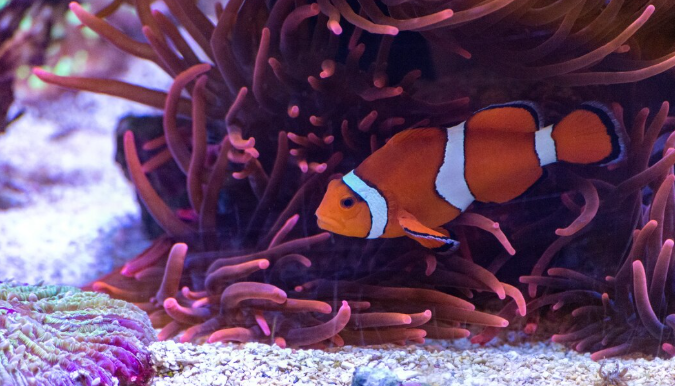
A tiny orange fish darts in and out of a swaying column of tentacles that would paralyze nearly any other creature that touched them somewhere in the warm shallows off the coast of northern Australia. Without hesitation, it moves, weaving, circling, and sometimes completely disappearing into the creature’s arms. The anemone remains motionless. It never does. In one way or another, the two of them have been doing this for what is thought to be millions of years. Additionally, witnessing it in person—even on a video screen—creates an emotion that is hard to describe. Something in between awe and a little skepticism.
The majority of people are familiar with this relationship from a Pixar movie. However, no animated version could adequately convey the messier, more fascinating, and sometimes more poignant nature of the real biology. The clownfish, which belongs to the subfamily Amphiprioninae and has 28 known species throughout the Indo-Pacific, has developed a unique characteristic that enables the entire setup: a mucus coating that is so chemically specific that it stops the anemone’s stinging cells, known as nematocysts, from firing at all.
| Category | Detail |
|---|---|
| Relationship type | Mutualism — both species benefit; clownfish gain shelter and food, anemones gain nutrients, cleaning, and defense |
| Clownfish species | 28 recognized species within subfamily Amphiprioninae; includes the famous Amphiprion ocellaris (“Nemo” species) |
| Natural habitat | Tropical Indo-Pacific waters — near Australia, Southeast Asia, Southern Japan, and the National Marine Sanctuary of American Samoa |
| Key clownfish adaptation | Specialized mucus coating rich in glycoproteins prevents discharge of anemone’s nematocysts (stinging cells) — providing full immunity to the venom |
| Anemone’s defense mechanism | Nematocysts — venomous harpoon-like threads that paralyze prey on contact; lethal to most reef fish but harmless to clownfish |
| Nutrient exchange (discovered 2008) | Auburn University study confirmed that ammonia-rich clownfish waste fertilizes anemone tissue, accelerating growth and regeneration |
| Clownfish behaviors benefiting anemone | Removes parasites and dead tentacles; defends against butterflyfish; increases water circulation and oxygen supply through swimming movement |
| Egg-laying behavior | Clownfish lay eggs roughly twice a month on flat surfaces near the anemone — within reach of the tentacles for protection |
| Broader ecological role | Relationship supports coral reef biodiversity; anemone health is tied to reef integrity; loss of symbiosis signals ecosystem stress |
| Cultural recognition | Featured in Pixar’s Finding Nemo (2003) — one of the most recognized marine species globally as a result |
These nematocysts are quite large. The majority of fish on the reef have learned through hard experience to stay away from them, and they release poisonous, harpoon-like threads that can paralyze prey upon contact. The clownfish just swims in, covered in slime that is rich in glycoproteins.
The question of whether clownfish are born with this immunity or develop it over time through cautious, incremental exposure to the anemone—basically, developing a tolerance similar to how a person might acclimate to cold water—remains unresolved. There are proponents of both theories. It’s possible that the reality lies in the middle or varies depending on the species. There is no question that the adaptation is successful and that the relationship as a whole falls apart without it.
In a coral reef ecosystem, the anemone provides the clownfish with a fortified home that is genuinely difficult to replace. The tentacles don’t attract predators who might otherwise hunt the slow-moving, bright fish. Because they take full advantage of this, clownfish hardly ever venture farther than a few yards from their host, and when they do, they return almost instantly. About twice a month, they lay their eggs on flat surfaces that are just close enough to the anemone’s protective reach. Although no strategy was ever developed, the arrangement follows the logic of a well-thought-out plan. It developed gradually over the course of evolution.
The list of benefits the anemone receives is substantial, and as researchers dug deeper, it continued to expand. As fierce protectors of their host, clownfish charge at butterflyfish, a species that is known to eat the tentacles of anemones, and chase them away with an almost personal tenacity. Additionally, they clean the anemone by removing dead tissue and parasites. Particularly at night when photosynthesis ceases and oxygen availability decreases, their continuous swimming in and out of the tentacles circulates the surrounding water, improving oxygen delivery to the anemone’s tissue. The clownfish performs this practical, unglamorous labor on a regular basis, seemingly without being asked.
Researchers at Auburn University made the most unexpected finding in this relationship in 2008, and it has to do with something that no one finds particularly poetic: fish waste. According to the study, the anemone directly absorbs ammonia-rich clownfish excrement and uses it as fertilizer for the photosynthetic algae called zooxanthellae that reside inside the anemone’s tissues. These algae are essential to the anemone’s diet, and the clownfish contributes to the system’s upkeep just by living, feeding, and excreting inside the tentacles. It’s a detail that, in some way, gives the partnership a more genuine feel, less like a nature documentary and more like a real working arrangement between two creatures that are inextricably linked.
When the two animals are the only focus, it’s simple to overlook a larger point. Anemones are a component of the structure of coral reefs, which are already under stress from rising ocean temperatures. This process, called bleaching, causes corals to expel their own symbiotic algae and eventually die. Clownfish rely on anemone populations, which decrease if the reef deteriorates. Fish that rely on anemones are affected in a cascading manner if their health declines. The relationship between anemones and clownfish is not closed-loop. It is part of a much wider network of dependencies, all of which are under stress now in ways that weren’t the case a generation ago.
It’s difficult not to interpret the clownfish’s tiny, colorful world—the tentacles, the territorial circling, the nitrogen cycling through fish waste into algae—as a form of debate. Not a sentimental one. Simply put, survival has rarely resembled independence in hundreds of millions of years of ocean life. Most of the time, it has appeared like this.
