

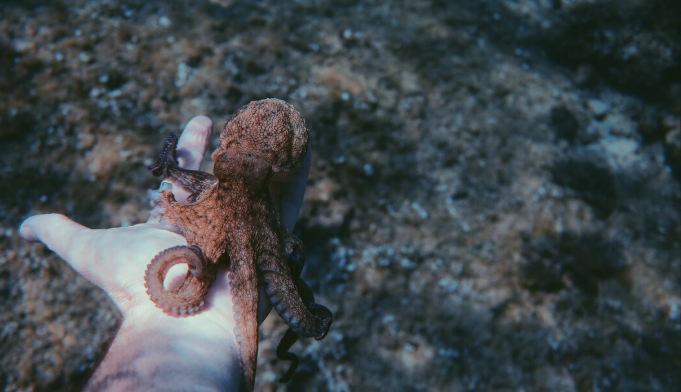
An octopus named Heidi, curled in her tank, starts to ripple at one point in a now-famous documentary clip. While she’s sleeping, her skin changes from pale white to bright yellow, then deep burgundy, then mottled green. Naturalist David Attenborough, the narrator, speculates that she may be dreaming. It’s like hunting dream crabs. Watching it, millions of people instantly came to believe him. It’s difficult not to.
Although the video was released in 2019, scientists have been troubled by the question it posed ever since. Is it possible for an octopus to dream? And what does it even mean to dream at all for an animal that has nine brains, one in the center and one in each arm? The answers get stranger and more intriguing the more researchers investigate.
| Category | Detail |
|---|---|
| Primary species studied | Octopus laqueus (Okinawa, Japan) and Octopus insularis (Brazil) |
| Lead research institutions | Okinawa Institute of Science and Technology (OIST), Japan; Federal University of Rio Grande do Norte, Brazil |
| Sleep stages identified | Two — quiet sleep (pale skin, motionless) and active sleep (rapid color/texture changes, eye flickers, muscle twitches) |
| Active sleep cycle interval | Every 30–40 minutes; active bursts follow quiet sleep periods of 6+ minutes |
| Comparable to human sleep | Resembles REM (rapid eye movement) sleep — the stage linked to vivid dreaming in humans, birds, and mammals |
| Evolutionary significance | Octopuses and vertebrates diverged ~500 million years ago — two-stage sleep likely evolved independently (convergent evolution) |
| Key 2023 study published in | Nature (June 2023) — brain probes used to record neural activity during sleep for the first time in cephalopods |
| Famous public case | Octopus “Heidi” filmed changing colors during sleep — footage went viral globally, sparking mainstream interest in cephalopod consciousness |
| Confirmed dreaming? | Not confirmed — octopuses cannot report their dreams. Evidence is behavioral and neurological, not subjective |
| Intelligence benchmarks | Maze-solving, tool use, problem-solving for food rewards; considered among the most intelligent invertebrates on Earth |
For a very long time, it was widely believed that only vertebrates could experience complex sleep, which is the kind of cycling between distinct active and quiet stages. birds, reptiles, and mammals. animals that have spines. The reasoning made some neat evolutionary sense. However, cephalopods—a class that includes squid, cuttlefish, and octopuses—have a way of upending neat presumptions. Video recordings from a few years ago indicated that something strange was occurring during their sleep. The skin was not silent. It was acting.
Octopus insularis that were captured in the wild were observed sleeping in tanks set up by researchers at the Federal University of Rio Grande do Norte in Brazil. They discovered a clear pattern: long periods of what they called “quiet sleep,” in which the octopus lay still with pale skin and slitted eyes, followed by short, startling bursts of “active sleep,” in which color flooded the skin, suckers contracted, limbs twitched, and the eyes flickered under their lids. Like clockwork, these active episodes came in about every 30 to 40 minutes. There was a clear indication that something was happening inside.
Further research was done in the 2023 study that was published in Nature. Octopus laqueus is a nocturnal species that conveniently sleeps through the day. Researchers at the Okinawa Institute of Science and Technology implanted electrodes and used brain probes, which are real recordings of neural activity. They discovered a true two-stage sleep cycle with neural patterns during active sleep that were similar to those observed during wakefulness, confirming and extending the findings of the Brazilian team. On an EEG, that is nearly exactly how human REM sleep appears. The brain doesn’t shut down. It changes modes.
One of the authors of the study, Sam Reiter, pointed out an intriguing aspect of why this species was such a suitable subject. Researchers were able to observe O. laqueus for extended periods of time without interruption because it sleeps continuously during the day. In science, small decisions frequently produce the most obvious outcomes. Here, an invertebrate’s dreaming, or at least dream-adjacent, life was revealed through a handy nocturnal habit.
There’s a chance that everything is purely mechanical. neural housekeeping, pattern processing, and memory sorting. Slow-wave sleep is believed to accomplish this in humans, though even that is still up for debate. Even more perplexing is the active phase, which is the REM equivalent. Nobody truly understands the purpose of dreaming or what it achieves. Given that octopuses, which are separated from vertebrates by about 500 million years of evolutionary history, appear to have evolved two-stage sleep independently, it must be performing a crucial function. If not, it wouldn’t continue to show up.
This raises a more general issue regarding intelligence in general. Researchers have long been taken aback by octopuses. They figure out mazes. They make use of tools. Their ability to identify individual human faces is almost unsettling when you think about it in an animal without a cortex. Two-thirds of their neurons reside in their arms rather than their central brain, demonstrating the extreme decentralization of their nervous system. Nevertheless, they plan, think, and adjust. Whatever intelligence is, it can develop without a vertebrate spine.
It’s still unclear what Heidi was doing that evening, whether she was processing sensory data, reliving a hunt, or feeling more like a dreaming mammal. According to Alexandra Schnell, a University of Cambridge researcher who focuses on cephalopod cognition, we are unable to verify that octopuses dream because they are unable to tell us. And that distinction is very important in science. It’s fascinating to watch the eye move and the skin flicker. It is not verification.
However, there is a persistent sense that the difference between “acting like something is happening” and “something actually happening” might be smaller than what science currently permits. Heidi’s footage wasn’t a light trick. The Okinawa brain recordings were clear-cut. Sleep is taking place somewhere in those underwater tanks, behind those odd horizontal pupils. What it means is still one of the more beautiful and genuinely open questions in animal science.
