

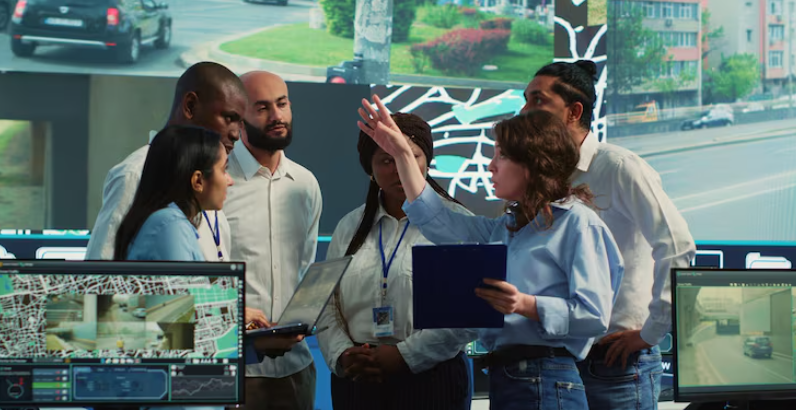
A certain type of business is never invited to the keynote stage. It doesn’t have a product that customers can download and play with on a Tuesday afternoon, nor does it have a charismatic founder giving TED talks. If you were to locate its offices, they would appear unremarkable: a rack of servers humming in a back room, rows of engineers, and whiteboards covered in network diagrams. These businesses don’t often follow trends. Seldom do they become viral. Nevertheless, none of the AI products that make headlines would be able to operate for even an hour without them.
The majority of publications tell stories about AI that revolve around models, such as which chatbot is faster, which language model is more intelligent, or which tech company is winning the arms race. It’s a gripping story, and it’s not entirely incorrect. However, it is lacking in a way that is crucial for anyone attempting to comprehend where the actual economic weight of this moment is settling.
| Category | Details |
|---|---|
| Topic | AI Infrastructure — The foundational layer powering the artificial intelligence economy |
| Combined Hyperscaler Capex (2026) | $600 Billion+ (Alphabet, Amazon, Meta , Microsoft) |
| Total Aggregate AI Capex | ~$1 Trillion per year |
| Key Infrastructure Players | Nvidia, AMD, Amazon AWS, Microsoft Azure, Google, Oracle, xAI |
| Notable Joint Venture | Stargate — SoftBank, OpenAI, Oracle data center project (announced Jan 2026) |
| Key Infrastructure Needs | Data centers, cooling systems, power grids, networking, cybersecurity, storage |
| Emerging Focus Area | Data governance, cybersecurity verification, tokenized data monetization |
| Key Private Company Tracker | Futuriom 50 Report (2026) |
| Reference Website | https://www.forbes.com/sites/ |
Together, the four biggest hyperscalers—Alphabet, Amazon, Meta, and Microsoft—have invested more than $600 billion in capital. When you include OpenAI, Oracle, and Elon Musk’s xAI, the total amount spent on AI infrastructure each year is close to $1 trillion. Algorithms are not covered by that amount. It covers the cost of concrete, fiber optic cables, cooling systems, specialized chips, and the electrical infrastructure needed to run an almost unfathomable amount of computation continuously.
A press release cannot adequately convey the physical scope of what is being constructed when you pass a contemporary AI data center outside of Phoenix or in the flat industrial corridors close to Dallas. These aren’t rooms for servers. They are closer to industrial campuses, which are expansive, climate-controlled buildings that need specialized water cooling systems and power substations to transfer heat from thousands of processors at once.
In order to power facilities that are currently under construction, Google has entered into energy agreements with NextEra and Brookfield Renewable. Data centers are being built at a rate and scale that would have seemed unthinkable five years ago thanks to the Stargate project, a joint venture between SoftBank, OpenAI, and Oracle that was announced in early 2026. AI has a vast physical reality that is mostly being assembled behind closed doors.
The most well-known brand in the GPU market, which enables AI training, is Nvidia. However, the backstory of Nvidia is equally fascinating, albeit much less well-known. Businesses like Redpanda, Databricks, MinIO, and Arcee AI are developing the software and data architecture layers that make raw computing power virtually worthless. The unglamorous mechanisms that determine whether an AI system truly operates at scale or just crashes when actual enterprise demand hits include storage, orchestration, data movement, and security. In ten years, some of these names might become commonplace. The engineers who rely on them on a daily basis and the analysts who follow Futuriom’s private company reports are currently the only people who know them.
Beneath the hardware story, there is an architectural change that merits greater consideration. AI is simultaneously pushing infrastructure design in two directions: distribution at the edge, where data is generated and latency cannot be tolerated, and increased centralization in massive hyperscale facilities. A new generation of tools is needed to manage both at the same time, and the companies developing those tools are raising a lot of money without getting much media attention. Observing this industry’s growth gives me the impression that the pattern is familiar; it resembles the early internet infrastructure build-out, when the businesses creating routing protocols and laying fiber were far less well-known than the websites that ran on top of them until they weren’t.
Perhaps the most underappreciated aspect of this story is its cybersecurity component. The CEO of Datavault AI, Nathaniel T. Bradley, has been making a claim that breaks through the model-obsessed discourse: intelligence based on unsecured, unverified data is structurally unstable, regardless of how well it performs on benchmarks.
When you consider how AI models are actually being used, it is hard to dispute his company’s main claim, which is that there is insufficient third-party verification of cybersecurity across AI systems. Systems built on digital foundations that have, for the most part, never undergone independent audits are receiving sensitive data. The courts have not yet fully addressed the liability issue. Whether it will affect the platforms, the developers, or the businesses using these tools is still up in the air. However, it is approaching, and businesses constructing infrastructure for data valuation and governance are preparing for that confrontation.
Here, the historical parallel is difficult to ignore. Every technological era has a fundamental layer that is overlooked in the rush of early adoption. Before the internet could be used for commerce, it needed payment rails and protocols. Before businesses could trust cloud computing with sensitive operations, it needed an imperceptible but strong security architecture.
AI is approaching a similar turning point, where people outside of the engineers in charge of it can see the difference between what the technology promises and what the infrastructure can really support. The businesses that are closing that gap don’t make a big deal out of it. Data centers, architecture reviews, patent applications, and infrastructure contracts—all of which hardly ever make the financial press—are where they do it.
This investment reasoning is timeless. Picks and shovels vendors frequently outperform miners during any gold rush. The equivalent of picks and shovels for AI is currently being produced by dozens of businesses that are either privately held or operate under names that the majority of ordinary investors have never entered into a search engine. It remains to be seen if that changes as the infrastructure buildout develops. However, the $1 trillion flowing into this layer implies that the answer has already been determined somewhere by people who know what they’re looking at.
