

For the majority of the night, Las Cumbres Observatory’s control room lights remain dim—the kind of low glow that keeps astronomers awake without blinding their screens. Outside, the sky over the Chilean desert appears unbelievably clear, with stars strewn like frost across the gloom. A few scientists are seated quietly inside, watching data come in from telescopes aimed at an event that occurred a billion years ago.
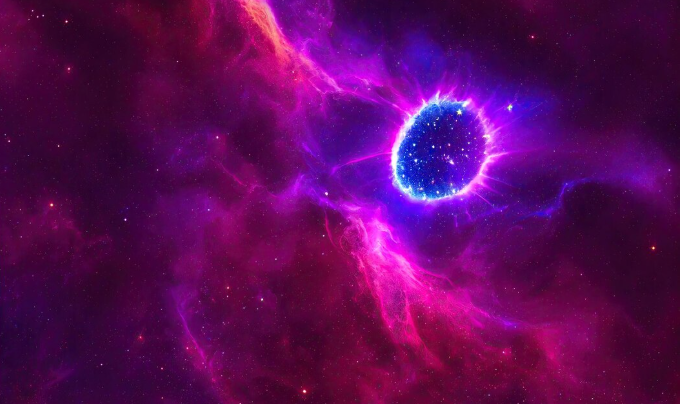
There is an explosion from a star. Not just any star, but a supernova, a magnificent cosmic explosion. These occurrences are already among the universe’s brightest phenomena. They can outshine entire galaxies for a few weeks. However, this specific explosion seemed even brighter than anticipated, inspiring the kind of subdued suspicion that astronomers come to rely on.
| Category | Details |
|---|---|
| Cosmic Event | Supernova |
| Special Type | Superluminous supernova (10–100× brighter than normal explosions) |
| Stellar Remnant | Magnetar |
| Observatories Involved | Las Cumbres Observatory |
| Additional Telescope | ATLAS survey telescope |
| Distance of Event | Roughly 1 billion light-years from Earth |
| Key Research Field | Astrophysics |
| Scientific Importance | Helps explain why some supernovae are extraordinarily bright |
| Reference | https://www.reuters.com/science/ |
Inside it, something odd was taking place. Initially, the data was presented as a set of light curves, which are graphs that depict how the explosion’s brightness changed over time.
The pattern appeared familiar at first glance. Usually, supernovae brighten quickly before gradually fading. This one, however, pulsed in waves of brightness that increased and decreased over several months. As the pattern emerged, scientists began to wonder why some supernovae are so incredibly bright—a question that has plagued astrophysics for almost twenty years.
There’s a feeling that the solution was always waiting inside the explosion.
Researchers now think that a compact object called a magnetar—basically, the crushed core of the dead star—lies at the center of the event. Imagine a city-sized object spinning hundreds of times per second with a magnetic field strong enough to erase a credit card halfway to the moon. Astrophysicists have been discreetly cataloging these objects for years, despite the fact that they seem almost unreal.
The outer layers of the massive star exploded into space when it collapsed. However, the magnetar persisted, whirling wildly in the middle of the growing cloud of debris. Large amounts of energy were injected into the explosion by that spinning motion, which resembled a hidden engine buried inside the explosion.
The reason why some supernovae become “superluminous,” shining 10 to 100 times brighter than normal stellar explosions, may be explained by this internal engine.
The more researchers examine the physics, the more bizarre it becomes. The surrounding debris appears to be drawn into a disk around the magnetar by its gravity, forming a swirling structure resembling the accretion disks found around black holes. Space-time itself is twisted as the disk rotates due to the magnetar’s intense gravity, a phenomenon that Einstein’s general theory of relativity predicted.
The phenomenon is known to astronomers as Lense-Thirring precession. The disk sways. The energy entering the explosion varies. And billions of years later, scientists can see the supernova’s brightness rising and falling in faint waves from Earth.
It’s difficult to avoid feeling a subdued sense of wonder as you watch those patterns develop on a screen. Long before complex life existed on Earth, the signals started their journey across space. These days, telescope mirrors pick them up as faint photons.
A surprisingly wide range of cosmic questions are addressed by the discovery. Supernovae are factories that create many of the heavy elements in the universe; they are more than just spectacular fireworks. Violent stellar deaths like this one are the source of iron, nickel, and even the calcium found in human bones. Knowing the precise mechanism of these explosions has ramifications that go well beyond astronomy textbooks.
Additionally, a more comprehensive puzzle is concealed here. Unusual supernovae, according to some astronomers, could be used to gauge the universe’s expansion rate and provide insight into dark energy, the enigmatic force driving cosmic expansion. Although the relationship is still unknown, the prospect keeps researchers looking at their data a little longer than they had intended.
The screens in the control room continue to glow softly late at night, long after most observatories have gone silent. Every new measurement that comes in from the ATLAS survey telescope and partner telescopes worldwide provides a new piece of information about a long-dead star.
Whether this one explosion will solve the puzzle of superluminous supernovae is still up for debate. Seldom does science operate so neatly. Three more questions are often raised by a single discovery.
However, astronomers believe that something significant has just been revealed—a secret engine within one of the universe’s most violent events, subtly altering the narrative of how massive stars die.
